
Discover how the Hallmarks of Ageing are reshaping skincare and explore CORUM’s L.O.N.G.E.V.I.T.Y. Strategy for supporting healthier, more resilient skin over time.
For decades, anti-ageing skincare has primarily focused on correcting the visible signs of ageing, such as wrinkles, sagging, and uneven skin tone. As scientific understanding of ageing continues to advance, however, the focus is shifting from simply correcting what appears on the skin to understanding and supporting the biological processes that shape how skin ages over time. This evolving perspective has given rise to skin longevity — an approach centered on preserving skin resilience, repair capacity, structural integrity, and overall biological functionality throughout the ageing process.
The evolving Hallmarks of Ageing framework has provided a more systematic understanding of ageing by identifying interconnected biological processes that contribute to functional decline over time. 1 Yet many of these processes are reflected in biological markers that CORUM has been investigating long before longevity became a defining concept in skincare.
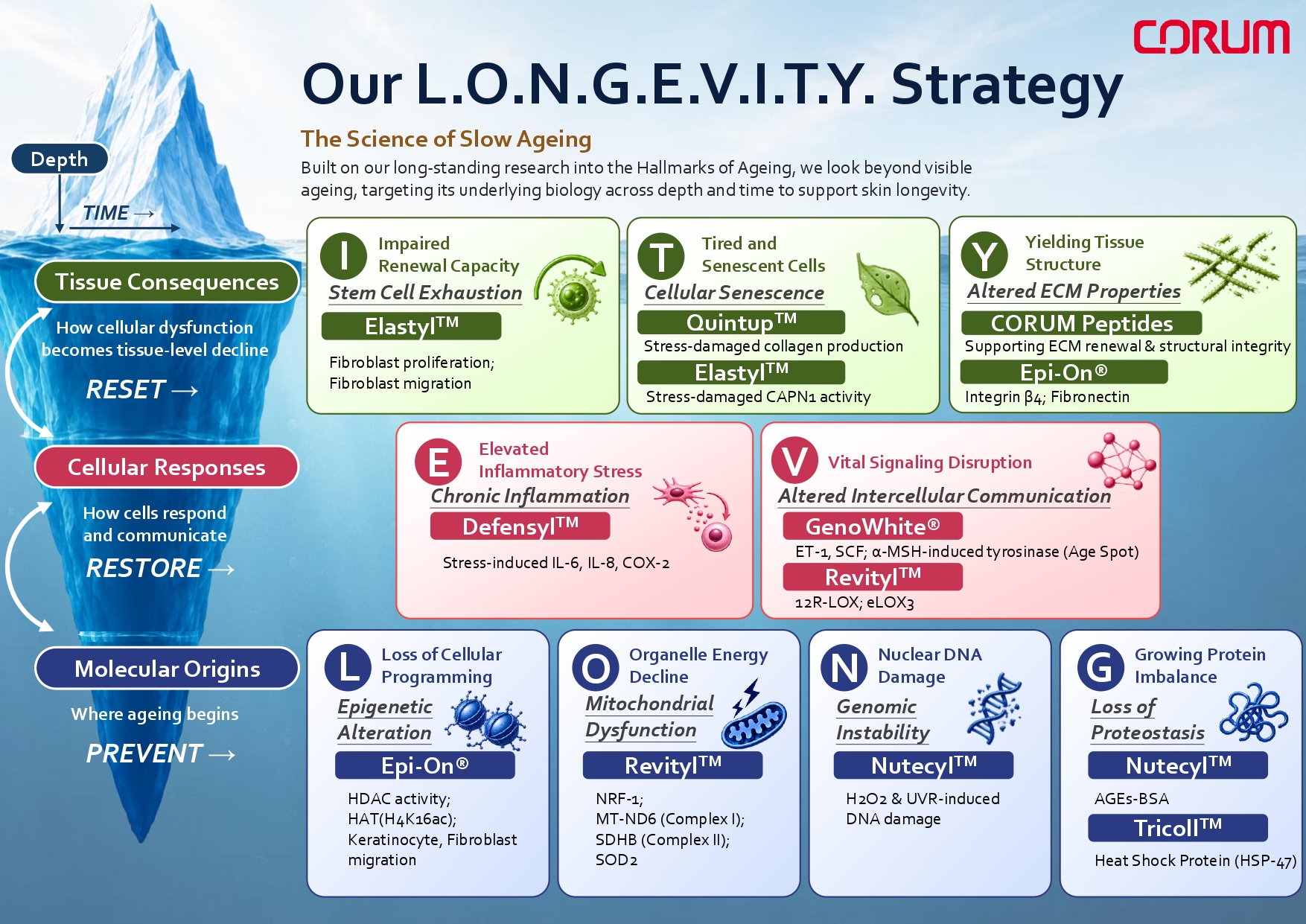
Building on this long-standing body of research, CORUM frames the science of slow ageing through an ageing-iceberg framework that connets visible signs of skin ageing with the underlying biology through two complementary dimensions: biological depth and intervention time. Across biological depth, the nine dimensions of L.O.N.G.E.V.I.T.Y. span three interconnected levels of ageing biology:
Across intervention time, these three levels correspond to three perspectives for slowing the progression of ageing: Prevent, Restore, and Reset.
Together, these depth-and-time dimensions form the foundation of CORUM’s L.O.N.G.E.V.I.T.Y. Strategy. LONG addresses Molecular Origins, with an emphasis on Prevent; EV focuses on Cellular Responses, where the aim shifts toward Restore; and ITY links Tissue Consequences, where intervention moves toward Reset. In this way, CORUM brings together decades of biomarker-driven research, contemporary understanding of the Hallmarks of Ageing, and a depth-and-time perspective on skin biology — translating the science of slow ageing into a comprehensive strategy for skin longevity.
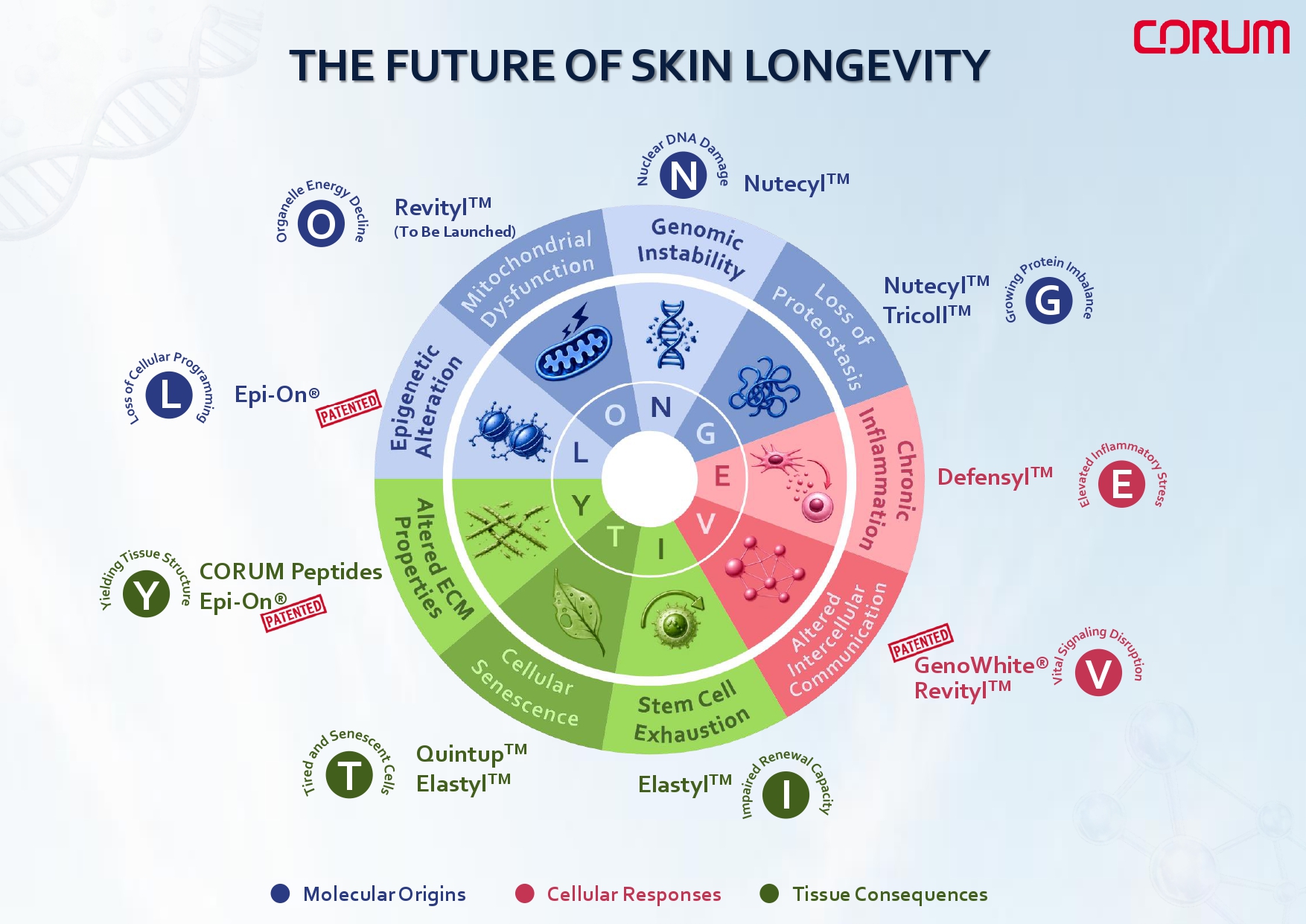
LONG-Molecular Origins: Where ageing begins | PREVENT
L — Loss of Cellular Programming — Epigenetic Aleration
Ageing is not only driven by structural decline, but also by progressive alterations in cellular programming. Over time, accumulated environmental stress and biological damage can disrupt youthful gene expression patterns, alter epigenetic regulation, and abnormal post-translational modification of histones. These epigenetic alterations are increasingly recognized as important contributors to functional and visible skin ageing.1
Supporting the preservation of youthful cellular functionality therefore becomes an important strategy in longevity-oriented skincare. Epi-On® helps support epigenetic pathways associated with healthier and more resilient skin ageing through HDAC inhibition and enhanced histone acetylation, two mechanisms closely associated with epigenetic regulation and cellular functionality.1
Next-generation sequencing (NGS) analysis further demonstrated that Epi-On® regulates genes associated with growth factors, cellular vitality, and inflammatory responses, supporting healthier cellular functionality and adaptive resilience. To examine how these regulatory effects translate into cellular behavior, migration assays evaluated the responsiveness of keratinocytes and fibroblasts—two cell types central to skin renewal and repair.
These improvements in cellular functionality, tissue renewal, and structural integrity may ultimately translate into visible skin recovery benefits. Together, these findings connect Epi-On®’s epigenetic activity with preserved cellular responsiveness and regenerative potential. By helping maintain youthful cellular programming and supporting the functional capacity of keratinocytes and fibroblasts, Epi-On® contributes to a more longevity-oriented approach to resilient skin ageing.
O — Organelle Energy Decline — Mitochondrial Dysfunction
Mitochondria are the primary energy-producing organelles that regulate cellular bioenergetics, redox homeostasis, and adaptive stress responses. During ageing, mitochondrial dysfunction progressively compromises mitochondrial quality and cellular metabolism, contributing to functional decline across multiple hallmarks of ageing.1
Maintaining mitochondrial function has therefore emerged as an important strategy in longevity-oriented skincare. Beyond cellular energy production, healthy mitochondria also help maintain redox homeostasis and adaptive cellular resilience. RevitylTM supports mitochondrial function through complementary mechanisms involving mitochondrial biogenesis, antioxidant defense, and cellular bioenergetics.
Healthy mitochondrial function depends on efficient mitochondrial biogenesis and respiratory capacity. RevitylTM supports mitochondrial biogenesis and energy metabolism by upregulating genes associated with mitochondrial function.
Mitochondria are a major source of reactive oxygen species (ROS). During ageing, excessive mitochondrial oxidative stress accelerates mitochondrial dysfunction and contributes to cellular damage.1 RevitylTM helps maintain mitochondrial redox homeostasis by enhancing endogenous antioxidant defense.
Improved mitochondrial membrane potential and oxidative balance ultimately translate into healthier mitochondrial function. RevitylTM helps preserve mitochondrial activity while reducing oxidative DNA damage.
By supporting mitochondrial biogenesis, strengthening antioxidant defense, and improving mitochondrial performance, RevitylTM helps maintain cellular bioenergetics, adaptive resilience, and healthier skin functionality during ageing.
N — Nuclear DNA Damage — Genomic Instability
The nucleus serves as the control center of the cell, housing genetic information essential for cellular function, repair, and regeneration. However, cumulative environmental stress can contribute to genomic instability and DNA damage, gradually impairing cellular functionality and adaptive resilience over time.1 Maintaining genomic integrity is therefore becoming an increasingly important aspect of longevity-oriented skincare.
NutecylTM MB/CC-MB helps protect genomic integrity by reducing environmentally induced DNA damage and supporting healthier cellular functionality.
By helping preserve genomic integrity and reduce cumulative DNA damage, NutecylTM MB/CC-MB may support long-term cellular performance and healthier skin ageing.
G — Growing Protein Imbalance — Loss of Proteostasis
Proteostasis, the maintenance of properly functioning proteins within cells, is essential for healthy skin ageing. As skin ages, damaged, misfolded, or glycated proteins gradually accumulate, impairing protein quality control systems and disrupting cellular homeostasis. This progressive loss of proteostasis is increasingly recognized as one of the major hallmarks contributing to functional decline associated with ageing.1
Among the factors contributing to proteostasis loss, glycation and impaired protein quality control play complementary roles. Glycation occurs when excess sugars non-enzymatically react with structural proteins such as collagen and elastin, leading to the formation of advanced glycation end products (AGEs). The accumulation of AGEs impairs protein functionality, reduces structural flexibility, and accelerates the deterioration of skin structure during ageing.1
Meanwhile, Heat Shock Protein 47 (HSP47) is a collagen-specific molecular chaperone that plays a critical role in collagen folding, maturation, and quality control. By supporting collagen homeostasis, HSP47 contributes to maintaining extracellular matrix integrity and preserving protein functionality during ageing.8
To support multiple aspects of proteostasis, CORUM combines complementary longevity technologies targeting both protein protection and protein quality control.
NutecylTM MB/CC-MB helps reduce glycation-associated protein damage by inhibiting AGE formation.
TricollTM MB/CC-MB supports collagen quality control by enhancing HSP47 expression.
By reducing glycation-associated protein damage while supporting collagen quality control, NutecylTM MB/CC-MB and TricollTM MB/CC-MB help preserve protein homeostasis, contributing to healthier skin functionality and long-term resilience during ageing.
EV-Cellular Response: How cells respond and communicate | RESTORE
E — Elevated Inflammatory Stress — Chronic Inflammation
Chronic low-grade inflammation, commonly known as inflammageing, is increasingly recognized as a key contributor to accelerated biological ageing.1,7 Environmental stressors such as UV radiation and blue light exposure can trigger pro-inflammatory cascades, progressively impairing skin functionality and accelerating ECM degradation over time.1 Controlling chronic inflammation therefore becomes an essential strategy in longevity-oriented skincare.
DefensylTM MB/CC-MB helps support healthier skin ageing by modulating inflammation-related pathways associated with environmental stress exposure.
By helping regulate chronic inflammation and reduce environmental stress-induced inflammatory responses, DefensylTM MB/CC-MB may support healthier, more resilient skin.
V — Vital Signaling Disruption — Altered Intercellular Communication
One of the important aspects of skin ageing is the progressive disruption of intercellular communication.1 As skin ages, environmental stress and accumulated cellular damage can alter the production of signaling molecules that coordinate communication between keratinocytes, fibroblasts, and melanocytes. This dysregulated communication may contribute to uneven skin tone, age-associated pigmentation, and other visible signs of skin ageing. Among these communication pathways, pigmentation-related signaling plays a particularly important role in age-associated skin appearance.9
Age-associated pigmentation, including uneven skin tone and age spots, is increasingly recognized as a consequence of altered communication between keratinocytes, fibroblasts, and melanocytes.9 Under environmental stress conditions, signaling molecules such as Endothelin-1 (ET-1), α-MSH, and Stem Cell Factor (SCF) may become overexpressed, continuously stimulating melanocytes and contributing to persistent hyperpigmentation.
GenoWhite® helps support healthier skin communication by regulating upstream pigmentation-related signaling pathways associated with ageing and environmental stress.
Clinical studies further demonstrate the visible benefits of regulating pigmentation-related communication pathways during ageing.
By helping regulate pigmentation-related communication pathways associated with ageing and environmental stress, GenoWhite® contributes to a more longevity-oriented approach to skin radiance, tone uniformity, and healthier pigmentation balance. In this evolving perspective, youthful skin is not simply skin that looks younger — it is skin that continues to communicate, adapt, and maintain biological balance over time.
Intercellular communication in the epidermis also depends on lipid-derived signaling. Sphingolipids and their metabolites function not only as structural components of the skin barrier, but also as bioactive mediators involved in keratinocyte differentiation, stress responses, and epidermal homeostasis. Within this pathway, 12R-lipoxygenase (12R-LOX) and epidermal lipoxygenase-3 (eLOX3) act sequentially to generate oxidized lipid mediators that support proper epidermal differentiation and barrier organization.
By reinforcing this lipid-mediator pathway, Revityl™ also helps support epidermal homeostasis as a complementary dimension of healthy intercellular communication. In parallel, communication between keratinocytes and melanocytes is essential for maintaining balanced pigmentation.
ITY-Tissue Consequences: How cellular dysfunction becomes tissue-level decline | RESET
I — Impaired Renewal Capacity — Stem Cell Exhaustion
One of the defining characteristics of youthful skin is its regenerative capacity, the ability to continuously renew, repair, and restore tissue functionality over time. Ageing-associated stem cell exhaustion is linked to reduced tissue renewal under steady-state conditions and impaired tissue repair following injury. In highly regenerative tissues such as the skin, maintaining cellular plasticity and repair-associated functions become increasingly important for preserving tissue functionality during ageing.1
However, as ageing progresses, regenerative efficiency gradually declines due to stem cell exhaustion and reduced cellular adaptability. This loss of regenerative potential contributes to slower recovery, impaired repair responses, and visible signs of skin ageing.
Supporting long-term regenerative capacity therefore becomes a fundamental strategy in longevity-oriented skincare. ElastylTM MB/CC-MB helps support repair-associated cellular functions involved in skin regeneration and recovery.
By supporting regenerative functionality and adaptive recovery, peptide technologies may help maintain healthier skin performance throughout the ageing process.
T — Tired and Senescent Cells — Cellular Senescence
Throughout daily life, our skin is continuously exposed to environmental and biological stressors, including UV radiation, pollution, oxidative stress, and psychological burden, which can progressively compromise skin functionality over time. Beyond extrinsic aggressors, chronic stress has increasingly been recognized as a major contributor to stress-induced cellular senescence and premature skin ageing. Persistent stress can trigger biological processes associated with senescence, including impaired tissue repair, extracellular matrix deterioration, barrier dysfunction, and reduced adaptive capacity, ultimately contributing to functional decline during ageing.1
Elevated cortisol levels induced by continuous stress exposure may impair skin barrier functionality, reduce adaptive recovery capacity, and accelerate stress-associated functional decline and cellular dysfunction over time.2 Supporting the skin’s defense against ongoing stress therefore becomes an essential strategy in longevity-oriented skincare.
At the structural level, chronic stress can cause cellular senescence resulting in impaired collagen synthesis, accelerated ECM deterioration and visible skin ageing.3,4 Corum’s QuintupTM MB/CC-MB helps support ECM recovery under stress conditions by restoring collagen production following stress-induced damage.
In addition to ECM alteration, cortisol may also repress Calpain-1 activity, potentially disrupting filaggrin processing and reducing natural moisturizing factor (NMF) production, ultimately contributing to dry and senescence-associated skin dysfunction.
By supporting stress recovery pathways and adaptive resilience, QuintupTM MB/CC-MB and ElastylTM MB/CC-MB may help reduce stress-associated functional decline during skin ageing.
Y — Yielding Tissue Structure — Extracellular Matrix Changes
The extracellular matrix (ECM) is far more than a structural scaffold. Increasingly, it is recognized as a dynamic microenvironment responsible for cellular communication, tissue organization, repair signaling, and mechanical resilience.5 During ageing, ECM fragmentation and collagen degradation progressively disrupt these biological networks, accelerating structural and functional decline within the skin.6 Maintaining ECM homeostasis therefore requires a coordinated strategy involving collagen synthesis, degradation control, elasticity preservation, and structural support.
Within this context, signaling peptides offer a targeted approach to supporting ECM renewal. Certain peptide signals can act as biological messengers that modulate fibroblast activity and matrix production. For example, procollagen-derived peptide sequences have been shown to stimulate the production of key ECM components, including type I and III collagen and fibronectin,11 while other endogenous peptide signals have demonstrated the ability to promote collagen synthesis in fibroblasts.12 These findings provide a mechanistic basis for peptide-based strategies designed to support ECM maintenance and structural resilience.
Building on this biological principle, CORUM’s signaling peptide portfolio supports pathways associated with ECM maintenance, tissue renewal, and structural recovery. Importantly, longevity-oriented skincare should not rely on mechanistic evidence alone. Translating biological activity into meaningful skin outcomes requires clinical validation, demonstrating that support at the molecular and cellular levels can ultimately be reflected in visible skin performance.
Clinical studies with CORUM signaling peptides demonstrated improvements in skin smoothness, firmness, wrinkle appearance, and structural recovery:
By combining targeted peptide signaling with clinically validated improvements in skin quality and recovery, CORUM’s signaling peptide platform provides a multidimensional approach to supporting ECM resilience and healthier-looking skin throughout the ageing process.
Beyond peptide signaling, Epi-On® also supports tissue renewal and structural recovery through downstream effects on key ECM- and adhesion-related markers:
These improvements in tissue renewal and structural integrity may ultimately translate into visible skin recovery benefits. Clinical studies further demonstrated accelerated skin recovery benefits of Epi-On® following laser treatment. Immediate reductions in erythema and skin redness were observed after treatment, with continued improvement over time. After 5 days, erythema color was reduced by up to 60%, demonstrating enhanced skin recovery and resilience.
By supporting ECM-associated markers, dermal–epidermal adhesion, and post-procedure recovery, Epi-On® complements CORUM’s signaling peptide platform with tissue-level evidence for structural resilience and healthier skin recovery.
A New Paradigm for Resilient Ageing
The shift from traditional anti-ageing toward Skin Longevity represents a fundamental evolution in skincare science. Rather than focusing solely on correcting visible signs of ageing, longevity-oriented skincare aims to preserve the biological functionality, adaptability, and communication networks that support healthy skin over time.
As the hallmarks of ageing become increasingly interconnected, maintaining youthful skin can no longer rely on single target approaches alone. Instead, healthier skin ageing requires a multidimensional strategy capable of supporting regeneration, stress adaptation, proteostasis, genomic integrity, ECM integrity, inflammageing balance, epigenetic functionality, and intercellular communication simultaneously.
Through Corum’s L.O.N.G.E.V.I.T.Y. Strategy, these longevity-oriented actives are strategically applied to support multiple biological pathways associated with long-term skin functionality and adaptability. Ultimately, skin longevity is not only defined by the absence of wrinkles, but also by the skin’s ability to continuously communicate, recover, adapt, and maintain functional integrity throughout the ageing process.
By targeting multiple hallmarks of ageing, Corum’s longevity strategy helps support skin that remains resilient, responsive, and radiant far beyond the surface. Because longevity is not about stopping skin ageing, it is about helping skin remain resilient enough to age beautifully.
References:
Note: Product efficacy results presented in this article are based on CORUM internal in vitro, ex vivo, and/or clinical studies.
 Language